 English
 Deutsch
 Pусский
 Español
 Français
 Português
Why the Right Solar Connector Can Make or Break Your PV System’s Longevity


Solar panels, inverters, string layouts – you’ve planned everything. But the tiny plastic piece connecting each panel to the next rarely gets a second thought. That’s the solar connector. A cheap one adds resistance, traps heat, and turns into the weakest link in your entire PV system. Years of UV, freezing nights, rain, and thermal cycling will crack its housing or corrode its contacts – leading to arcing, power loss, or worse. This guide walks you through voltage/current ratings, IP protection, contact materials, and the manufacturing rigor that separates a 20‑year connector from a five‑year failure.
Where the Real Risk Hides – Inside the Plastic Housing
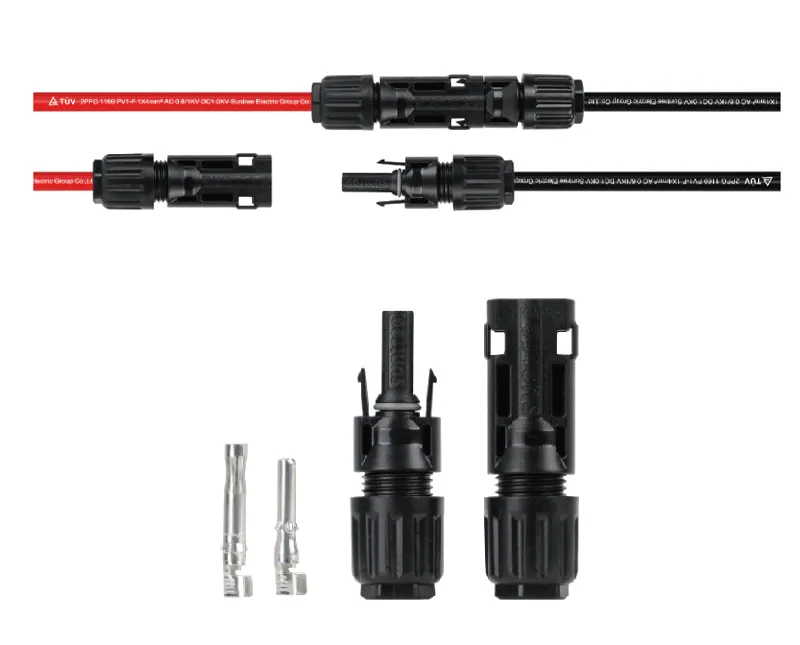
A solar connector looks simple. Two metal contacts, a plastic housing, and a locking nut. But the hidden risks are inside.
Contact resistance – the silent heat source
The metal contact is stamped from copper alloy and plated with tin or silver. If the contact is poorly designed or the plating is too thin, resistance rises. Higher resistance means heat. Heat accelerates oxidation. Oxidation raises resistance further – a self‑amplifying failure loop. A good solar connector holds contact resistance below 0.5 milliohms after environmental testing. SUNTREE’s connectors undergo 200 thermal cycles (-40°C to +85°C) while monitoring contact resistance drift.
Moisture ingress leads to corrosion, then to heating, then to failure. A connector rated IP68 can withstand temporary immersion (1 meter for 30 minutes). But the seal must survive thermal cycling – expansion and contraction that can pump moisture in. SUNTREE’s connectors are tested through multiple extreme environment simulations, including salt spray (ISO 9227) and mixed flowing gas (MFG) tests to simulate coastal or industrial pollution.
Material degradation – UV and cold
Cheap plastic housings crack under UV exposure or become brittle in freezing temperatures. UV‑stabilized PPE/PC blends maintain mechanical strength for 20+ years. Look for UL94‑V0 flammability rating for safety. SUNTREE’s connectors use halogen‑free materials that also resist tracking (CTI ≥ 600V), reducing leakage current risk in high‑humidity conditions.
Sizing a Connector to Your PV System – Voltage and Current
Using an underrated connector is like putting a thin wire in a high‑power circuit. The consequences are not immediate but accumulate over years.
Voltage rating – 1000V vs. 1500V
Modern utility‑scale systems run at 1500V DC to reduce string losses. A 1000V connector will arc and fail at 1500V. Choose the rating that matches your inverter and string design. For residential systems (typically 600‑1000V), a 1000V connector is adequate. For commercial ground‑mount, always specify 1500V.
Current rating – matching panel Isc
A typical 550W panel has an Isc around 15A. But in high‑irradiance conditions (bifacial panels, snow reflection), current can exceed 18A. A 20A connector is marginal. A 30A or 50A connector gives headroom. SUNTREE offers connectors up to 70A for high‑power modules.
Temperature derating
Connector current ratings are often given at 25°C ambient. On a hot rooftop, the connector may run at 70°C, reducing its current capacity by 20‑30%. Account for derating in design. SUNTREE provides derating curves in their technical datasheets.
A solar connector that is properly sized will run cool and last decades. Using a connector with 50% headroom extends life significantly.
What Decades of Extreme Environment Testing Reveals
SUNTREE has been manufacturing cable solutions for nearly 20 years. Their database covers 500+ projects in extreme environments worldwide – from deserts (Dhabi, Nevada) to arctic sites (Norway, Canada) to offshore floating solar.
Real‑world failure patterns
The most common failure mode is not sudden breakage but gradual contact resistance increase. Over time, oxidation and micro‑motion wear the plating. SUNTREE’s in‑house testing includes thermal cycling, UV exposure (1000h accelerated), and salt spray (720h) to simulate 20 years of use. Their data shows that connectors with silver‑plated contacts maintain low resistance 3× longer than tin‑plated under thermal cycling.
The 50+ R&D team advantage
With over 50 engineers covering electrical, material, and mechanical disciplines, SUNTREE designs connectors from the ground up – not off‑the‑shelf components. They control the contact geometry (optimizing the spring force for low insertion force yet high contact pressure), the plastic compound (proprietary UV‑stabilized blend), and the sealing design (double O‑ring).
Digital traceability – tracking every batch
SUNTREE’s digital traceability system records raw material certificates, production parameters, and test results for every batch. If a field issue arises, you can trace the connector to its origin – right down to the molding machine and shift. This level of detail is critical for warranty claims and root‑cause analysis.
From Raw Material to Finished Connector – A Traceable Path
Full‑process quality control is not a slogan; it’s a system with documented procedures.
Halogen‑free materials only
SUNTREE fully adopts halogen‑free materials. No chlorine, no bromine. This reduces toxic smoke in case of fire and meets environmental regulations like RoHS, REACH, and the stricter EU Construction Products Regulation.
Supplier screening
Only environmentally certified suppliers (ISO 14001) are selected. Each shipment of plastic pellets or copper strip is tested for heavy metals – lead, cadmium, mercury, and hexavalent chromium – before entering production. Non‑conforming materials are rejected at the dock.
In‑line testing
Every connector is tested for contact resistance (4‑wire Kelvin method), insulation resistance (≥1000 MΩ), and dielectric strength (2500V DC) before leaving the factory. Random samples from each batch undergo thermal cycling and UV exposure. SUNTREE’s test reports are available on request.
A solar connector from a manufacturer with full traceability gives you confidence that each piece meets the same standard – not just the sample.
Safety Inspection – Independent and Systematic
SUNTREE has established an independent product safety testing process, not relying solely on supplier certificates. Their lab is equipped to perform the following.
Multi‑dimensional experimental validation
Tests include:
High‑potential (hipot) testing: 3000V DC for 1 minute, no breakdown
Contact resistance (milliohm): measured with 10A test current
IP68 immersion: 1 meter for 30 minutes, then electrical test
UV exposure (accelerated aging): 1000h, 60 W/m², followed by mechanical impact test
Thermal cycling: -40°C to +85°C, 200 cycles, with resistance measured every 50 cycles
Salt spray: 720h, 5% NaCl, 35°C
Damp heat: 85°C / 85% RH for 1000h
Compliance with international safety standards
Connectors meet IEC 62852 (for PV systems), UL 6703 (for North America), and EN 50521 (for European markets). SUNTREE also provides CB test reports for global acceptance.
Real‑time supply chain data
The digital traceability system allows you to access test reports for your batch via a lot number. No more guessing. Just scan the QR code on the packaging to download the PDF report.
Installation Tips – Common Mistakes to Avoid
Even the best connector fails if installed incorrectly.
Do not use tools to tighten beyond finger‑tight
Over‑tightening cracks the plastic housing or damages the O‑ring. Hand‑tighten until the seal engages, then a quarter turn more.
Keep contacts clean
Dust, sand, or moisture on contacts before mating increases resistance. Keep connectors capped until final connection. Blow out any debris with compressed air.
Match manufacturers
Not all connectors are compatible across brands. Even if they physically fit, contact alignment and sealing may differ. Use connectors from the same manufacturer for the entire string, or use certified inter‑mateable brands.
Check the click
A properly mated connector makes an audible click. After mating, pull gently to confirm the lock is engaged. Unlocked connectors can vibrate apart over time.
How to Specify Solar Connectors for Your Next Project
Use this checklist when ordering:
-
Rated voltage: 1000V or 1500V DC?
-
Rated current: at least 1.25 × panel Isc
-
IP rating: IP68 minimum
-
Contact plating: tin or silver? (Silver has lower resistance but higher cost)
-
UV resistance: 20+ years guaranteed?
-
Halogen‑free: yes/no?
-
Certificates available: IEC 62852, UL 6703?
-
Traceability: batch‑level test reports?
Get a Sample Kit
You don’t need to order thousands to test quality. SUNTREE can send a sample set of solar connectors in the rating you need. Test the mating force, inspect the seal, and check the contact resistance. Ask for the test report for that batch.
A solar connector that is properly engineered, rigorously tested, and fully traceable will keep your PV system running for decades.
-0943.webp)