 English
 Deutsch
 Pусский
 Español
 Français
 Português
Application of Solar Harness in Rooftop and Ground-Mount Arrays


You‘re standing on a rooftop, looking at rows of PV modules. Each one needs to be wired to the next. That’s hundreds of connections—each one cut, stripped, crimped, and tested in the field. On a ground-mount site, it‘s the same story, just with more mud and longer cable runs.
A Solar Harness changes this workflow. It’s a pre-assembled wiring system with factory-terminated connectors, designed to match specific array layouts. Instead of building the wiring harness on-site, you simply lay it out and plug it in. Suntree‘s SH Series solar harnesses are qualified in TUV and ETL labs with solar professional standards, having passed both IEC1500V and UL1500V certifications. They feature IP68 waterproof rating, UV resistance, and a wide operating temperature range from -40°C to 85°C.
This guide explores how solar harnesses are applied in two main installation contexts: rooftop arrays and ground-mount systems. We’ll cover the specific challenges of each environment, the trunk-and-drop vs. branch harness designs, special considerations for tracker systems, installation best practices, and a cost-time comparison. For system designers and EPC engineers, this is a practical guide to choosing the right wiring solution for your next project.
Less Time on the Roof
Rooftop installations are among the most challenging environments for field wiring. Space is tight, safety is paramount, and every minute on the roof costs money.
The Challenges – Limited Space, Safety Risks, and Roofing Materials
Working on a roof means confined spaces, fall protection gear, and constant awareness of roof integrity. Wiring a conventional system requires running individual cables between modules, securing them to the racking, and making connections—all while working at height. Different roofing materials—metal, tile, asphalt, membrane—each present their own challenges for cable routing and securing.
How Harnesses Reduce Rooftop Time
A solar harness is pre-configured to match the module layout. Instead of measuring and cutting cables on the roof, you lay out the harness along the array and plug in the connectors. This dramatically reduces the time your crew spends at height. The SH Series harnesses from Suntree are designed with high-quality materials that guarantee long-term reliability, with lower contact resistance and higher current transfer capability ensuring high product efficiency.
Typical Design – Trunk Along the Eave
For most rooftop arrays, the typical design places the trunk cable along the eave or ridge, with drop cables running up to each row of modules. A single harness can serve 2-4 rows, depending on the module layout and row length. The trunk is secured to the racking with cable clips, and the drop cables are routed to the module junction boxes. This design minimizes the number of cables running across the roof surface, reducing the risk of damage and improving aesthetics.
Ground-Mount Made Simpler
Ground-mount systems present a different set of challenges: long cable runs, environmental exposure, and wildlife interference.
The Challenges – Long Distances, Ground Faults, and Wildlife
In a ground-mount system, the distance from the array to the inverter can be hundreds of meters. Long cable runs increase the risk of voltage drop and ground faults. Wildlife—rodents, in particular—can chew through exposed cables. Field conditions—mud, dust, temperature extremes—also take a toll on cable insulation and connections.
How Harnesses Address These Issues
Solar harnesses for ground-mount systems are factory-tested for insulation integrity, reducing the risk of ground faults caused by damaged insulation. The SH Series is rated IP68, providing complete protection against dust and immersion. The cables have excellent weather resistance and can withstand high and low temperatures, UV radiation, ozone, humidity and other natural factors. The high mechanical strength of Suntree‘s solar wiring harnesses can withstand mechanical stresses such as tension, pressure, and bending during installation and maintenance.
Real-World Impact
The time savings on a ground-mount site are significant. One installer reported a 40% reduction in wiring labor on a 2MW project using pre-assembled harnesses. The reduction comes from eliminating cable measuring, cutting, and termination on-site—tasks that are particularly time-consuming in field conditions.
Two Designs, Two Layouts
Not all solar harnesses are the same. The choice between trunk-and-drop and branch harness designs depends on your array layout.
Trunk-and-Drop – For Regular Rectangular Arrays
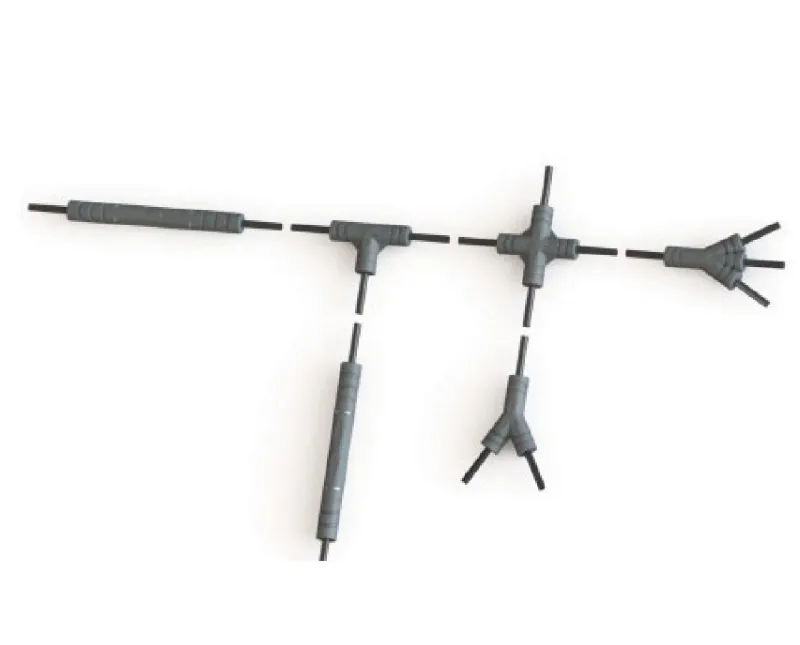
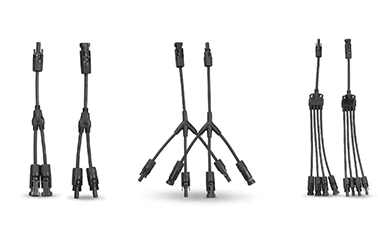
A trunk-and-drop harness features a main trunk cable with multiple T-shaped branch points along its length. Each drop cable connects to a single module or a small group of modules. This design is ideal for regular rectangular arrays where modules are laid out in straight rows with consistent spacing. The trunk runs along the row, and drops go up to each module. Suntree‘s SH-T Branch is one example of a T-style branch solution.
Branch Harness – For Irregular Layouts
Branch harnesses use Y-shaped or H-shaped splits to accommodate irregular array layouts. They‘re more flexible than trunk-and-drop designs, allowing the harness to follow the module layout even when rows aren‘t perfectly straight. The SH-Y Branch and SH-X Branch from Suntree are designed for these applications, with cable specs ranging from 4 mm² to 16 mm² and a voltage rating of 1500V.
How to Choose
The decision comes down to array shape and consistency. If your array is a regular rectangle with uniform row spacing, trunk-and-drop is the more efficient choice. If your array has irregular boundaries, multiple tilt angles, or obstacles that break the row pattern, a branch harness provides the flexibility you need.
Wiring That Moves
Tracker systems add a layer of complexity: the wiring needs to move with the modules.
Dynamic Cable Management
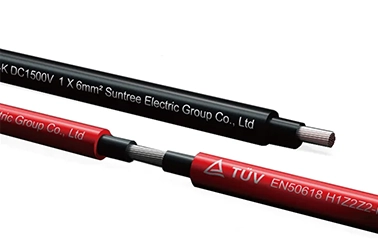
In a tracker system, the harness must accommodate continuous movement—rotation, tilting, and twisting. Standard cables can fatigue and fail under this dynamic loading. The harness must be designed with high flexibility and torsion resistance. Suntree‘s solar harnesses are built with high-purity copper cores as the conductive material, ensuring good electrical conductivity and significantly lower resistance, thus reducing the loss of electrical energy during transmission.
The Bend Test Requirement
A tracker-rated harness should pass a minimum of 10,000 bending cycles in a drag chain test. This simulates the constant flexing that occurs as the tracker follows the sun. Without this rating, cables can fail prematurely, leading to costly downtime and repair. Suntree‘s products have undergone long-term practice and rigorous environmental testing.
Preventing Tangling at Rotation Joints
At the rotation joint where the tracker moves, the harness must be secured to prevent tangling. Use cable carriers or articulated arms that guide the harness through its range of motion. Leave sufficient service loops at connection points to accommodate movement without putting tension on the connectors.
Install It Right
Even the best harness won‘t perform if it’s installed incorrectly. Here are the practices that make a difference.
Lay Out Before Connecting
Before you start plugging in connectors, lay out the entire harness along the array. This lets you verify that the harness length matches the array layout and that all branch points are correctly positioned. Adjustments are much easier before the harness is secured.
Secure the Trunk – No Sagging
The trunk cable should be secured to the racking at regular intervals—typically every 1-1.5 meters. Use UV-resistant cable clips or ties that won’t degrade in sunlight. Avoid letting the trunk sag between supports, as sagging creates stress points and can cause cable damage over time.
Leave Service Loops
At each connection point, leave a small service loop—enough cable to allow for connector replacement without re-running the entire harness. A 15-20cm loop is usually sufficient. This foresight saves significant time when a connector needs to be replaced years later.
Don‘t Over-Tighten Cable Ties
Cable ties should be snug but not tight enough to deform the cable insulation. Over-tightening can damage the insulation and create a path for moisture ingress. A good rule: you should be able to slide the tie along the cable with moderate resistance, but it shouldn’t move freely.
What You Gain
Switching to a solar harness isn‘t free, but the savings are real.
Upfront Cost vs. Installation Savings
The upfront cost of a pre-assembled harness is higher than the raw materials for on-site wiring. The harness includes factory-terminated connectors, tested assemblies, and engineering time to design the layout. However, the installation labor savings are significant. On a typical ground-mount project, harnesses can reduce wiring labor by 30-40%. On a rooftop, the savings are even more pronounced because of the reduced time at height.
When Harnesses Make the Most Sense
Harnesses are most cost-effective on projects with more than 500 modules. Below that threshold, the engineering cost to design the harness may outweigh the labor savings. Above it, the labor savings compound quickly. For large-scale projects, the total project timeline can be reduced by 15-20% simply by eliminating field wiring.
The Intangible Benefits
Beyond cost and time, harnesses reduce the risk of wiring errors. Factory-terminated connectors are tested before shipment, eliminating the field failures that come from poor crimps or incorrect polarity. The result is a more reliable system with fewer callbacks.
Questions System Designers Ask
Can a solar harness be used with all module types?
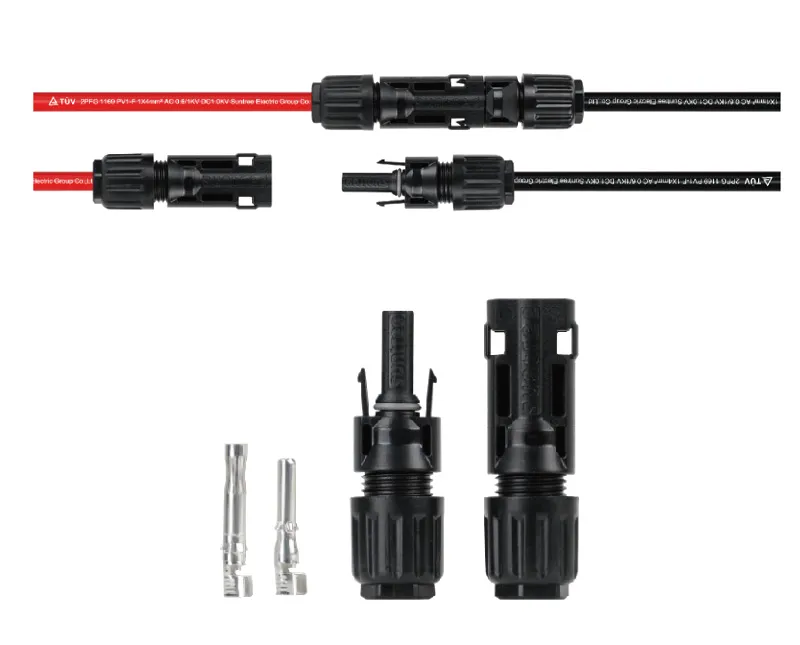
Most solar harnesses are designed to be compatible with standard MC4 or MC4-compatible connectors. However, different module manufacturers may use slightly different connector designs. Suntree‘s product design fully considers the interface and electrical characteristics of mainstream equipment on the market, ensuring seamless connection and improving system integration flexibility. Before ordering, verify the connector compatibility with your specific module brand.
How do you handle harness length variation on sloped roofs?
On a sloped roof, the distance from the trunk to each row of modules varies. A well-designed harness accounts for this by providing drop cables with different lengths or by specifying a harness that follows the roof contour. For complex roof geometries, consider using a branch harness that allows more flexibility in routing. Some suppliers, including Suntree, offer custom harness designs based on project-specific layouts.
What is the maximum number of branches on a single trunk?
The maximum number of branches depends on the current rating of the trunk cable and the total current of the connected modules. For a 1500V system with a 50A-rated trunk, you can typically connect 8-12 strings, depending on module wattage and string configuration. Suntree‘s SH Series has a maximum rated current of 50A and is rated for DC 1500V, providing capacity for most commercial and utility-scale arrays.
Matching Harness to Project
Choosing the right harness for your project comes down to a few key decisions.
The Quick Reference Table
| Project Type | Recommended Harness | Key Consideration |
|---|---|---|
| Rooftop, regular array | Trunk-and-drop (SH-T) | Pre-configured to row layout |
| Rooftop, irregular layout | Branch harness (SH-Y/SH-X) | Flexibility for complex roofs |
| Ground-mount, large-scale | Trunk-and-drop with heavy-duty trunk | Long runs, wildlife protection |
| Tracker system | High-flex harness with drag chain rating | Dynamic movement tolerance |
| Small project (<500 modules) | Traditional on-site wiring | Harness engineering cost may not pay off |
How to Specify
When specifying a solar harness for your project, provide the supplier with: array layout (module positions and spacing), module connector type, system voltage and current requirements, and any site-specific conditions (temperature extremes, UV exposure, wildlife risk). Suntree‘s technical R&D team of over 50 people covers all key areas, and the company has delivered over 500 large-scale projects worldwide with proven, risk-optimized cable solutions for complex operating conditions.
Suntree has nearly 20 years of industry experience in providing cable solutions for renewable energy, energy storage, electric vehicle charging, and industrial automation. Their SH Series Solar Harnesses are qualified in TUV and ETL labs with solar professional standards, having passed both IEC1500V and UL1500V certifications. The harnesses feature IP68 waterproof rating, UV resistance, high mechanical strength, and a wide operating temperature range from -40°C to 85°C.
Suntree’s full-process quality control ensures every cable possesses excellent electrical performance and environmental compliance through rigorous supply chain screening and material standard control. The company uses halogen-free materials, selects only environmentally certified suppliers, and limits the content of lead, cadmium, and other heavy metals. Service support includes 24/7 technical support, free samples for physical verification, and service centers and local warehouses in multiple locations worldwide.
A solar harness is a practical solution for simplifying PV array wiring—particularly on projects with more than 500 modules. It reduces installation time, lowers labor costs, and improves reliability by eliminating field terminations. The choice between trunk-and-drop and branch harness designs depends on your array layout. Tracker systems require high-flex harnesses that can withstand continuous movement. When specified correctly and installed properly, a solar harness can transform a complex wiring job into a straightforward plug-and-play process.
Ready to explore solar harness options for your next project? Reach out to Suntree‘s technical team—they can provide custom harness designs, free samples, and application guidance based on your specific array layout and site conditions.
-0943.webp)