 English
 Deutsch
 Pусский
 Español
 Français
 Português
Why Does a Solar Connector Need IP68 at the Branch?


A Solar Connector on a single string has one mating interface to protect. A branch connector has that interface plus the internal confluence where several conductors meet—and that's the point where moisture does the most damage. You'll see why the IP68 rating is aimed at the branch body, what else the environmental envelope covers, and how the input count changes the current rating.
What Questions Come Up Before Sealing a Branch?
Isn't IP68 the same on any connector?
The rating is the same; the exposed surface isn't. On a 1-to-1 pair, the seal protects the mating interface between two connectors. On an n-to-1 branch, the housing also encloses the internal junction where multiple inputs converge. If water reaches that junction, it contacts several conductors at once and the corrosion path is broader than at a single mated pair. The page lists IP68 for the whole A4 nB1 series, which covers the branch body as well as the input and output interfaces.
What else does the environmental envelope cover?
IP68 addresses water and dust; the page adds UV resistance, a -40℃ to +85℃ ambient range, UL94-V0 fire resistance, and a 16KV rated impulse voltage, with IEC 62852 certification and Class II pollution degree. Those are separate failure paths. UV degradation cracks the housing over years of sun exposure; the temperature range covers cold commissioning and rooftop heat build-up; the impulse rating addresses transient overvoltages from switching or nearby lightning. A branch connector has to survive all of them, not just the rain.
Why the Confluence Point Is the Weak Spot
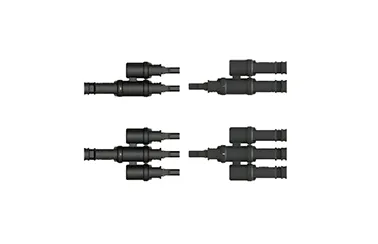
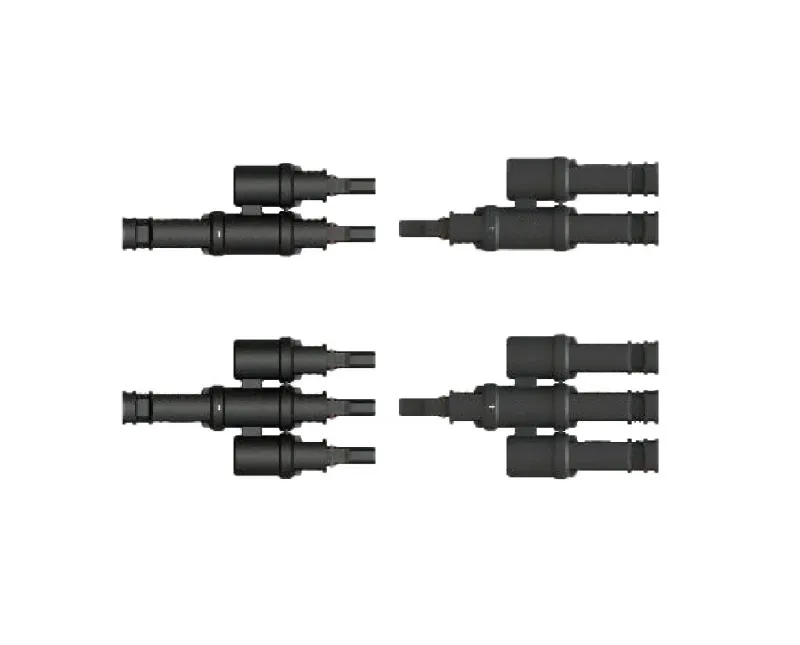
A branch connector's job is to bring several string inputs into one output. That means the current from every input passes through an internal junction before it reaches the output terminal. On a 5-to-1 model, five separate conductor paths meet inside one housing.
That internal junction is the part a simple mated pair doesn't have. On a 1-to-1 connector, the only electrical interface is the mating contact, and that interface is sealed by the connector's own gasket. On a branch, the internal junction sits behind the housing wall, and its protection depends on the housing remaining sealed for the life of the installation. That's why the IP68 rating on a branch connector is a structural requirement rather than a convenience feature—the seal is what keeps the internal confluence dry.
The page also lists UV resistance as a separate property. That matters because IP68 and UV resistance fail differently: a housing can stay watertight while its surface chalks and cracks under sunlight, and once the housing cracks, the IP68 protection is gone. The two ratings have to hold together.
What the temperature range says about the internal junction
The -40℃ to +85℃ ambient rating covers the outside environment. Inside the housing, the junction carries the combined current, so its temperature rises above ambient. The 70A output ceiling and the ≤0.25mΩ contact resistance are what keep that internal rise within the housing material's limits. A branch connector with higher resistance at the junction would run hotter inside the sealed body, and heat is what accelerates the degradation of both the seal and the housing.
Input Count and the Current Envelope
The order data makes the branch geometry explicit: the output is capped at 70A across the family, and the per-input rating steps down as inputs are added.
| Model group | Configuration | Input current | Output current |
|---|---|---|---|
| A4N001–A4N002 | 2 to 1 | ≤35A | Max 70A |
| A4N003–A4N004 | 3 to 1 | ≤23A | Max 70A |
| A4N005–A4N006 | 4 to 1 | ≤17.5A | Max 70A |
| A4N007–A4N008 | 5 to 1 | ≤14A | Max 70A |
The pattern is arithmetic: 70A divided by the input count gives the per-input ceiling, with a small margin. A 2-to-1 allows 35A per input; a 5-to-1 allows 14A. That's not a material limitation—it's the thermal balance of the common output path. If every input on a 5-to-1 carried 35A, the combined current would be 175A against a 70A output rating, and the internal junction would overheat inside its sealed housing.
Why the sealed body makes the current rating more critical
In an unsealed or ventilated assembly, heat can escape by convection. Inside an IP68 housing, the heat generated at the internal junction has a harder path out—it conducts through the housing material to the outside surface. That's why the current rating and the sealing rating are linked: a sealed branch connector has to hold its junction resistance low enough that the internal temperature stays within the housing's limits. The ≤0.25mΩ contact resistance figure is what makes the sealed design work at 70A.
Orientation, Materials, and Installation
The eight part numbers cover both female-to-male and male-to-female orientations, so the branch connector can match the polarity convention of the string leads it joins. The page describes the series as using high quality weather resistance materials for long-term reliability, and notes that the lower contact resistance and higher current transfer capability support high product efficiency.
-
Orientation: female-to-male and male-to-female variants in every input count
-
Housing: weather-resistant material with UV resistance and UL94-V0 rating
-
Sealing: IP68 across the branch body and both interface ends
-
Contact resistance: ≤0.25mΩ at the connector level
-
Certification: IEC 62852, Class II pollution degree
What to check at commissioning
Confirm the input count against the per-string current, the orientation against the array's lead polarity, and the mating interface against the string connector type. The IP68 rating depends on both ends of each interface being mated correctly—an unmated input left open on a branch connector is an unsealed opening, regardless of the housing's rating.
Where the A4 nB1 Series Fits a PV Array
The Solar Connector A4 nB1 Series from Suntree is built around the sealed-branch role the page describes: 2/3/4/5 inputs merging into one output inside an IP68 housing, rated to IEC 1500V and a 70A output ceiling, with ≤0.25mΩ contact resistance, UV resistance, UL94-V0 fire resistance, and a -40℃ to +85℃ ambient range. The per-input current steps down as inputs are added—35A on the 2-to-1, 14A on the 5-to-1—so the sealed body's thermal balance stays within its rating. For a system designer specifying Solar Connector branches, the value sits in the internal confluence: the junction where several strings meet is protected by the same housing that seals the mating interfaces, rather than being a field splice that depends on tape and cable ties for weather protection.
What to confirm before choosing a branch model
Confirm the per-string current against the model's input rating, the combined current against the 70A output ceiling, and whether the installation exposes the connector to direct sunlight—if so, the UV resistance and the IP68 rating both have to hold for the service life. The page's order data gives the starting point; the array layout determines which input count and orientation fit.
Let's Match a Sealed Branch to Your Array
Send over your string count, per-string current, and exposure conditions—we'll help you check them against the A4N001–A4N008 input ratings, the 70A output ceiling, and the IP68 sealed body. Talk to Suntree about your Solar Connector requirements and get a configuration-level answer before you commit to the array wiring.