 English
 Deutsch
 Pусский
 Español
 Français
 Português
Frequently Asked Questions About Solar Harness in Large-Scale Installations


You’ve managed a large solar project before, so you know the drill. The field crews arrive, the modules are racked, and then comes the tedious part: cutting thousands of cables to length, stripping insulation, crimping connectors, and testing every single connection. On a 100 MW site, that’s weeks of labor, miles of wasted wire, and countless opportunities for crimping errors that show up years later as hot spots and system downtime.
A solar harness changes that equation entirely. Instead of field fabrication, every cable is cut, stripped, terminated, and tested in a controlled factory environment. The harness arrives on site labeled, coiled, and ready to lay out. This article answers the ten most common questions EPCs and procurement managers ask when considering pre-assembled solar harnesses for utility-scale and commercial PV installations — from cost comparisons to certification requirements, custom design to long-term maintenance.
What a pre‑assembled harness actually is — and isn’t
Let’s clear up the most basic question first. A solar harness is not just a bundle of cables tied together with zip ties — though that’s what some suppliers deliver. A proper pre‑assembled harness is a factory‑manufactured wiring assembly where every cable is cut to exact length, stripped, terminated with connectors, and electrically tested before it leaves the production floor.
The alternative is the traditional approach: on‑site assembly. Crews measure each string length, cut bulk cable spools, strip the insulation using handheld tools, crimp connectors with manual crimpers, and then test each connection with a multimeter. This process introduces variability: crimping pressure varies by operator, torque settings drift, environmental dust contaminates exposed conductors, and inaccurate cutting creates material waste.
A harness eliminates all of these variables. Machine‑crimped connectors achieve consistent mechanical pull‑off force spec after spec. Factory‑level insulation resistance and continuity testing catch faults before the harness ships, not after it‘s buried under modules. And because the assembly is pre‑labeled and laid out according to the site plan, installation becomes a matter of unspooling and connecting — no measuring, no cutting, no crimping.
From bulk spools to plug‑and‑play
Think of it this way. In a traditional installation, you’re essentially setting up a miniature cable assembly factory in a field. You need trained personnel, calibrated tools, weather protection, and quality control. Any of those factors slips, and you introduce a long‑term reliability risk.
In a harness‑based installation, the factory work happens indoors under controlled conditions. The on‑site crew simply positions the harness, plugs in the connectors, and moves to the next row. One study of a 370 MW solar farm found that using harnesses reduced the total length of LVDC cable required from 4,200 km to 2,800 km — a 33 % reduction in cable materials alone.
The real cost equation — why upfront price isn’t the whole story
Here’s what procurement managers often ask: “A pre‑assembled harness costs more per meter than bulk cable. Why would I pay that?”
Let’s break down total installed cost, not material cost. Traditional on‑site cabling includes the bulk cable itself, plus crimp connectors, plus labor hours for cutting, stripping, crimping, and testing, plus material waste from inaccurate cutting, plus rework costs when connections fail field testing, plus long‑term risk of poor crimps causing arc faults or hot spots.
Pre‑assembled harnesses shift cost from field labor to factory labor — and factory labor is both cheaper and more consistent. Studies show that harnesses reduce total system cost by 20–30 %, with the savings coming primarily from reduced labor hours, fewer installation errors, and shorter project timelines. For a 50 MW project, that difference can be millions of dollars.
On a real 370 MW installation, using harnesses cut the LVDC capital cost by 15 % and reduced cable length by one‑third. The harness cost more per meter, but the project used fewer meters and vastly less labor.
Where the savings come from
Three main drivers. First, installation speed. Harnesses operate on a plug‑and‑play principle — lay the harness, connect the modules, done. Some suppliers report installation time reductions of 50 % or more for string wiring using pre‑assembled systems. Second, material efficiency. Factory‑precise length calculations eliminate the 5–10 % waste typical of field cutting. Third, quality consistency. Every factory‑crimped connection is documented; field‑crimped connections are only as good as the technician‘s fatigue level on that particular afternoon.
For EPCs bidding on fixed‑price contracts, that predictability — knowing exactly how many labor hours each megawatt will require — is as valuable as the raw cost savings.
How custom design works — and what you need to provide
Solar farms are not off‑the‑shelf products. Row lengths vary, tracker spacing differs, combiner box locations shift during civil works. A harness that’s off by a meter creates more problems than it solves.
Good harness manufacturers work from your project’s actual layout drawings. You provide the string layout, module positions, and combiner box locations. Their engineering team runs cable routing algorithms to calculate exact branch lengths, trunk lengths, and connector placement. The result is a harness set where every branch reaches its designated module without slack or tension.
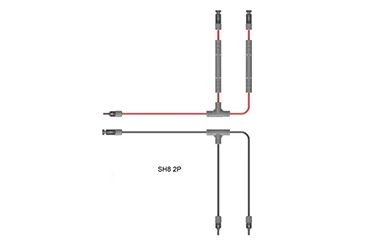
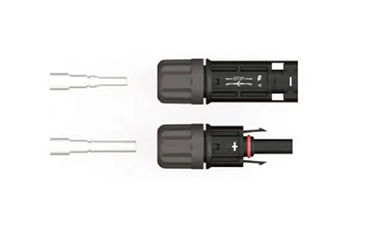
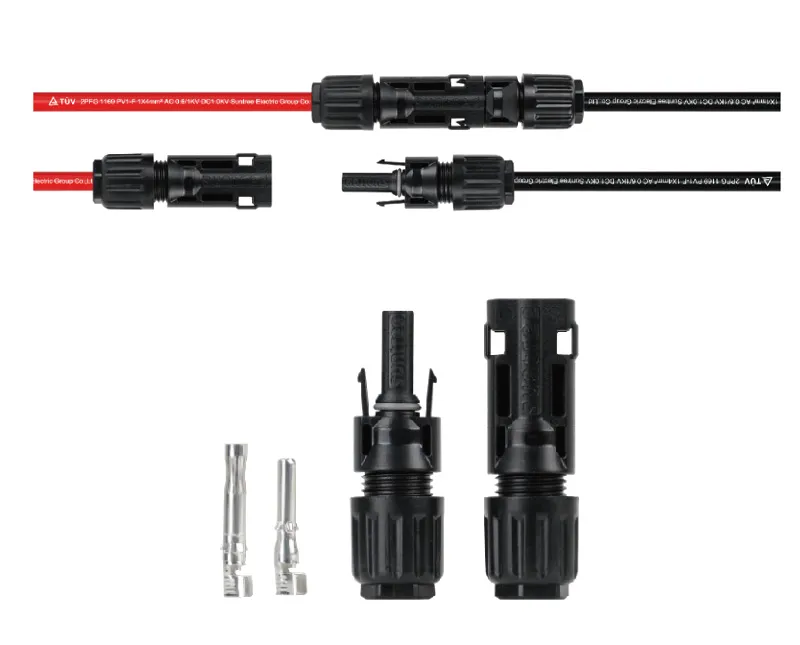
Customizable parameters include: cable gauge (typically 4 mm² to 16 mm² for DC power), trunk length, branch spacing and count, connector type (MC4, Amphenol, Staubli, or other certified PV connectors), overmolded fuse protection (2 A to 65 A), and labeling scheme for field identification.
Common branch configurations for large‑scale PV
| Configuration | Typical Use | Number of Inputs | Number of Outputs |
|---|---|---|---|
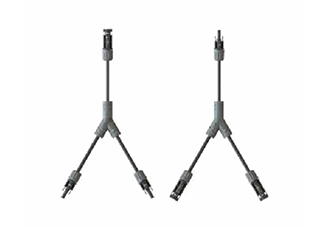
| Y‑branch (1-to-2) | Splitting one trunk into two branches | 1 | 2 |
| X‑branch (2-to-2) | Pairing two strings | 2 | 2 |
| T‑branch | Dropping a branch mid‑run | 1 (trunk) | 2 (trunk + drop) |
| Multi‑string (3-to-1, 4-to-1) | Combining multiple strings before combiner box | 3 or 4 | 1 |
For ground‑mount systems with long tracker rows, the trend is toward “trunk with drop cable” architectures — a main trunk cable runs the length of the row, and branch connectors tap off at each module position. This reduces the number of individual cable runs and simplifies wire management across the site.
Certifications and quality — what the safety labels really mean
When you’re buying thousands of harnesses for a utility‑scale project, you can’t visually inspect every crimp. That’s why certification matters. Here‘s what to look for.
UL 9703 is the North American standard for distributed generation wiring harnesses. It covers everything from cable insulation to connector retention to flame resistance. A harness certified to UL 9703 for 1500 V DC has passed rigorous factory production testing. Some suppliers also hold ETL certification to UL 9703 across 600 V, 1000 V, and 1500 V systems.
IP68 waterproof rating means the connector assembly is dust‑tight and protected against continuous immersion. For exposed outdoor installations — ground‑mount PV always counts — this is non‑negotiable. The Suntree DC 1500 V Y Branch harness carries an IP68 rating and UV‑resistant materials rated for 25+ years outdoor exposure.
Operating temperature range. Real solar farms see everything from desert heat to alpine snow. The Suntree harness operates from –40 °C to +85 °C, covering essentially any environment where PV is deployed.
How to verify quality before you order
Any supplier can claim “high quality.” Ask for three things. First, the UL 9703 certification file number — verify it‘s active. Second, test reports for insulation resistance and dielectric withstand voltage for the specific harness configuration you’re buying. Third, a sample harness for physical inspection. Check that the overmolding fully encapsulates the wire-to-connector transition — no exposed conductor, no gaps where moisture can wick in.
Some suppliers offer free samples specifically for physical verification, reducing selection and technical risks. Take advantage of that.
Maintenance — what you actually need to inspect over time
Pre‑assembled harnesses are not “set and forget.” Like any electrical system component, they require periodic inspection.
At a minimum, schedule quarterly visual inspections. Look for abrasion where cables rub against module frames or racking. Check that cable ties and clips remain secure — loose cables chafe over time. Inspect connector housings for cracking, especially in high‑UV environments where plastics eventually degrade.
Every 12 months, perform insulation resistance testing on a representative sample of harnesses. A significant drop in insulation resistance suggests moisture ingress or cable damage. For critical systems, some asset managers also conduct thermal imaging of connectors during operation — a hot connector indicates high resistance and potential failure.
Most manufacturers provide specific maintenance guidance. The key point: a well‑designed harness simplifies maintenance because cable routing is consistent and connections are uniform. Troubleshooting becomes easier when every string follows the same pattern.
More questions from the field — FAQ
Q: Is a solar harness more expensive than loose cable?
A: On a per‑meter basis, yes — factory assembly costs more than bulk cable. But total installed cost is 20–30 % lower once you account for reduced labor hours, lower material waste, and shorter project timelines. For a typical 50 MW project, the difference can exceed $500,000 in labor savings alone.
Q: Can I add extra branches to an existing harness?
A: No — and you shouldn’t try. Harnesses are manufactured as complete assemblies. Adding a branch in the field means cutting the trunk, stripping insulation, and installing an inline tap connector. That introduces exactly the kind of field‑termination risk that harnesses are designed to eliminate. If your site layout changes after the harness order, you reorder new harnesses with the updated configuration. That’s why good suppliers build flexibility into the ordering process — batch releases so you can adjust quantities as civil work progresses.
Q: What’s the typical lead time for custom solar harnesses?
A: For a utility‑scale project (100 MW+), lead times typically range from 4 to 8 weeks after final engineering approval. Some suppliers offer expedited prototyping in 1–3 days for sample verification, but full production volumes require longer. The critical path is often engineering — the more complete and accurate your layout drawings are, the faster the manufacturer can produce cut sheets.
Q: What voltage rating do I need for modern utility‑scale PV?
A: The industry standard has shifted to 1500 V DC systems for large ground‑mount installations, as higher voltage reduces line losses and allows longer string lengths. Ensure your harness is certified for 1500 V DC — not just 1000 V. The Suntree SH Series and Y Branch products are qualified in TÜV and ETL labs to both IEC1500V and UL1500V standards.
Q: How do I protect harnesses during construction?
A: Harnesses arrive coiled in protective packaging. During installation, keep them elevated off the ground to avoid abrasion from dirt and rocks. Avoid running cables across walkways where equipment traffic can crush them. After installation but before energization, perform a continuity test on each string. Some contractors use temporary lockout devices on connectors during construction to prevent accidental mating before all testing is complete.
Q: Are aluminum cables ever used in solar harnesses?
A: Yes, increasingly. Aluminum is lighter and less expensive than copper, though it requires larger gauge for equivalent ampacity. Some harness designs use aluminum for trunk cables — where low voltage drop is critical over long distances — and copper for branch drops to individual modules. The Suntree solution uses high‑purity copper cores as the standard conductive material, but hybrid designs are available for projects focused on material cost reduction.
How Suntree’s DC 1500 V Y Branch simplifies large‑scale PV wiring
Now let‘s connect the principles to an actual product line. Suntree’s DC 1500 V Y Branch Solar Harness is a pre‑assembled wiring solution designed specifically for utility‑scale and commercial PV installations. The Y‑branch configuration — a single input trunk splitting into two output branches — is the workhorse of string combining, allowing two module strings to be connected efficiently without combiner boxes.
The harness uses high‑quality materials that ensure long‑term reliability: lower contact resistance and higher current transfer capability improve overall system efficiency. The IP68 waterproof rating means the assembly survives rain, snow, pressure washing, and even temporary submersion — a necessity for outdoor PV. Operating temperature spans –40 °C to +85 °C, covering desert, alpine, and coastal environments.
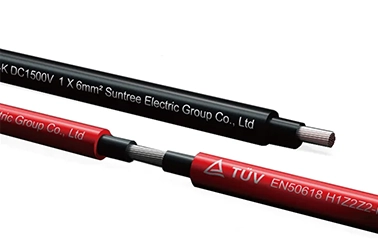
Rated voltage is UL1500V/IEC 1500V, with maximum rated current of 70 A for the Power Y Branch and 50 A for the SH Series, supporting cable sizes from 4 mm² to 16 mm². TÜV and ETL laboratory qualification confirms compliance with solar professional standards.
From a procurement perspective, Suntree offers support across the entire project lifecycle: 24/7 technical support for critical issues, free samples for physical verification, and service centers and local warehouses in multiple locations worldwide. For an EPC managing a 100 MW ground‑mount installation, the combination of certified 1500 V components, IP68 protection, and global logistics makes this harness platform worth evaluating.
Before you commit to a bulk order, request a sample harness and run it through your own quality checks: connector retention force, cable marking legibility, overmold integrity. A few hours of validation now prevents years of field failures.
Specifying solar harnesses for your next utility‑scale or commercial PV project? Contact Suntree for design consultation and a custom harness quote. Provide your system voltage (1000 V or 1500 V), cable gauge requirements, branch configuration preferences, and project layout — their engineering team will return optimized cut sheets and pricing for your specific site.